
India is becoming aware of the importance of implementing smarter, more efficient solar technologies in residential and commercial settings, given the high level of electricity consumption. These solar panels are no longer seen as only basic rooftop installations but as a system built on the latest advanced technology that fits well in any space, meets energy demand, is scalable, provides a good return on investment, and improves the standard of living. Let us see what bifacial solar panels are specifically designed to produce more energy from the same installation as compared to traditional solar panels.
What are Bifacial Solar Panels Technology and How Does It Work?
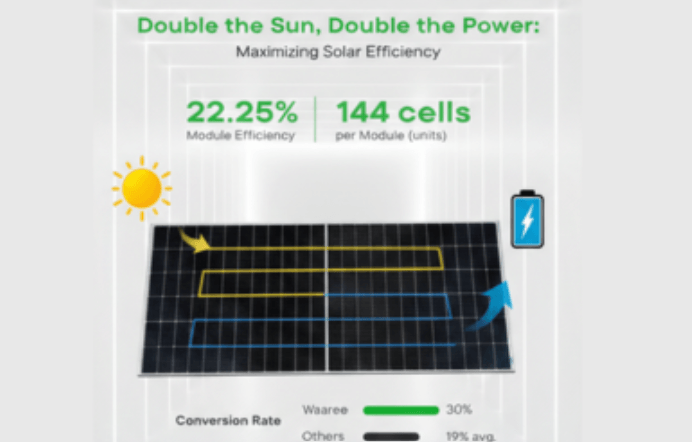
Before looking into the advantages, let us first see what is bifacial solar panels technology is. A bifacial solar panel is designed to absorb sunlight from both front and rear sides, unlike traditional solar panels that absorb only from the front surface. The front side of the bifacial panel absorbs sunlight, whereas the rear side absorbs reflected sunlight from surfaces such as concrete rooftops, white-coated terraces, or light-coloured ground.
This dual absorption capability enables the panel to generate more electricity without adding extra panels to the rooftop, making this technology a practical upgrade over the traditional mono-facial modules.
Bifacial Solar Panels: Structure and Design Advantage
Bifacial solar panels' structure plays an important role in the performance of bifacial solar panels. These panels come with a dual-glass design that absorbs sunlight from the front panel and absorbs reflected sunlight from the concrete floor into the rear panel, enhancing electricity production. The structure also provides better sturdiness, durability, and longevity, making it resistant to moisture and environmental stress, making it a long-term solution.
Double-Sided Solar Panels Vs Traditional Solar Panels
The key difference between double-sided solar panels and traditional solar panels is in energy utilization. Traditional panels can convert just direct sunlight, whereas bifacial panels also convert reflected and scattered light. This additional generation helps with better energy yield and improved return on investment
Performance Benefits of Bifacial Solar Panels
One of the biggest reasons buyers prefer bifacial solar panels is the improvement in overall system output. When installed correctly, bifacial systems can deliver noticeably higher generation compared to standard modules under the same conditions. This gain becomes more relevant over time; as better generation helps offset electricity costs faster. While bifacial solar panels' efficiency depends on installation height, tilt angle, and surface reflectivity, even moderate conditions can provide a measurable performance advantage.
In terms of real-world application, modules such as the WAAREE 590Wp 144Cells 24 Volts N-Type Framed Dual Glass Bifacial Non-DCR Solar Module reflect this design advantage well. Its dual-glass construction supports rear-side light absorption while offering higher durability and resistance to moisture, making it suitable for long-term rooftop and ground-mounted installations.
Cost Consideration and Long-Term Value
While evaluating solar systems, buyers often compare bifacial solar panels price with traditional panels. Although bifacial modules may carry a slightly higher upfront cost, the additional energy generation over the years often balances the difference.
Each bifacial module is designed to deliver consistent performance over a longer lifespan, making it a suitable choice for users focused on long-term savings rather than just initial pricing. This value-driven approach is why bifacial technology is increasingly adopted for both residential and commercial installations.
Choosing the Right Panels from Shop Waaree
When selecting high-quality solar bifacial panels, it is important to choose a trusted manufacturer and an official platform that offers product authenticity and installation support. Through shop.waaree, buyers can explore a wide range of bifacial panel options suited for different energy needs.
From high-wattage rooftop modules to complete on-grid bifacial kits, the platform allows customers to select products that align with roof size, power requirements, and budget. Waaree also provides access to authorised installation partners, ensuring that the system is installed correctly for optimal rear-side generation. For users looking for a complete and well-matched system, the WAAREE 590Wp 144Cells 24 Volts N-Type Framed Dual Glass Bifacial Non-DCR Solar Module offers an integrated solution that combines bifacial modules with compatible on-grid components. This ensures optimal system performance while simplifying installation and grid connectivity.
The solar energy system is being continually adopted in India, and with advanced technologies, it is only becoming a cost-effective solution for energy generation. Bifacial solar panels are one of the latest technologies that offer higher energy generation, are durable with dual-glass construction, and have improved long-term savings. They come with an added, practical advantage of absorbing even the reflected sunrays from the floor, thereby producing more energy in comparison to traditional solar panels. When installed correctly and maintained well, they become a future-ready investment for both homes and businesses.
Frequently Asked Questions
- What is bifacial solar panel technology best suited for?
Bifacial solar panels are ideal for installation on rooftops or on ground where there is adequate reflected sunlight available, like concrete or light coloured surfaces. - Does the bifacial solar panel structure affect installation?
The structure of bifacial solar panels affects installation, as a certain elevation with spacing is required, given the dual-glass structure. This allows the light to reach the floor and reflect that is absorbed by the rear surface. - Are double-sided solar panels suitable for homes?
Double-sided solar panels are suitable for use in residential rooftops where there is limited space available and higher output is needed. - Are bifacial solar panels' prices significantly higher than traditional panels?
The bifacial solar panels are relatively more expensive, but they help with recovering the expense incurred with improved generation of electricity. - How do I choose the right bifacial module for my system?
Choosing the right bifacial module depends on the size of the roof, required power, and the way installation is done. Make sure to consult an authorized professional to make this procurement and installation easy.




