

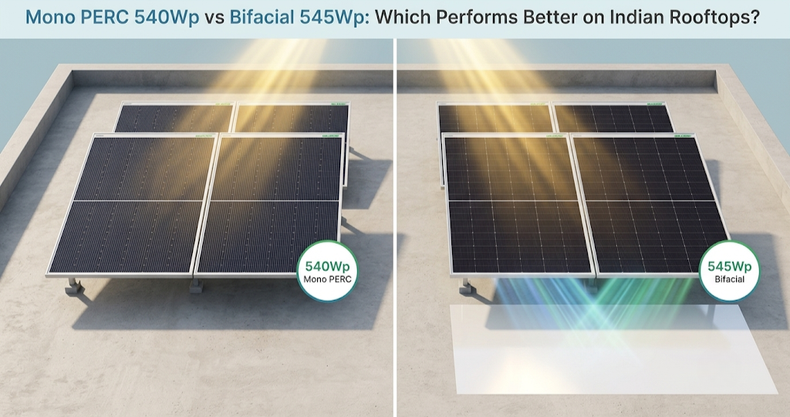
Selecting the appropriate solar panel technology can impact how effective energy production is over the lifespan of the roof-based system. Presently, two of the most commonly used solar panels for both residential and commercial setups in India are the Mono PERC 540Wp solar panel and the Bifacial 545Wp solar panel. Though both of these panels belong to the category of monocrystalline solar panels and the similarities do not end there, their differences can only be noted when one actually begins to study the working of these panels as they operate under Indian rooftop conditions. The following has been presented in order to clarify aspects regarding the mono-perc vs bifacial debate.
How Mono PERC Technology Works
The mono PERC solar panel is the version of solar panel that has PERC (Passivated Emitter and Rear Cell) solution technology, where solar cells are designed to have a reflective component on the back side. The reflective component has the ability to send back some of the sunlight that was not absorbed, thus enabling the cell to achieve greater efficiency as compared to the normal monocrystalline cells. An ideal example of the use of this technology is the Waaree 540Wp Mono PERC solar panel that comes with M10 mono cell technology and consists of 144 cells. This technology has become very well-known and successful among users all across India due to its high efficiency and low price.
How Bifacial Technology Works
The bifacial panel, as the name suggests, utilizes both sides of the panel for energy production. In particular, the back side of the bifacial panel is capable of capturing the reflected sunlight from the surface of the ground or the maximum surface area of any structure, as it is built to capture what is termed albedo. The Waaree 545Wp Mono PERC Bifacial solar module is an exemplary model of this technology, employing a dual-glass and frameless design and thereby enabling the collection of energy from reflected rays.
Mono PERC 540Wp vs Bifacial 545Wp: Key Comparison
Power Output and Efficiency
According to the specification, the 545w solar panel has a higher rated capacity compared to the 540Wp mono PERC panel. In practice, the difference is even bigger. The bifacial panels generate additional energy with their rear side, which helps the 545w solar panel produce much more energy than it was expected to generate under normal conditions.
Performance on Indian Rooftops
Indian rooftops are of different styles - they could consist of white terraces, metal sheds, or concrete. Bifacial panels work best when they can catch light rays with their rear side since these rays are reflected by the ground. On rooftops with a light surface under these solar panels, they can work much better than the standard 540Wp mono PERC panel. But when the roofs are dark, or the panels are tightly placed next to each other, the situation is different, a nd the performance difference becomes negligible.
Degradation and Long-Term Output
Bifacial panels are known to have a visibly lower rate of degradation over 25 years, thanks to their unique design (dual-glass and frameless). So while the difference in performance between a 540Wp and a 545Wp solar panel on day one may not be much, it is likely the gap will get progressively bigger in favor of bifacial technology as time goes on.
Weight, Design, and Installation
Mono PERC panels are comparatively lighter and simpler to work with when installing them because they only need to be assembled using a conventional aluminum frame and a single piece of glass. Weighing in at heavier, bifacial panels are constructed using two sheets of glass, which complicates their mounting due to the requirement for checking both the height of the mounting process and structural load capacity, particularly if the roof in question is lightweight.
Mono PERC Solar Panel Price vs Bifacial Panel Cost
One of the most significant contributing factors influencing buyers’ choice is the price of the mono PERC solar panel vs the price of bifacial panel models. Mono PERC panels are available at lower prices per watt due to the fact that their manufacturing process is more straightforward and a well-established procedure. Since bifacial panels are used to manufacture technological innovations, they typically come at higher price levels. Consequently, these models may be a more budget-friendly option for any homeowner.
Which One Should You Choose?
If you possess a dark-roofed house, have limited elevation, or have any restrictions on making light reflect correctly under the panels, a Mono PERC 540Wp panel might be the right choice for you, as it works perfectly and costs comparatively less. On the other hand, if your roof is light-colored or reflective and has sufficient height, then Bifacial 545Wp might be the right choice, as it creates much more energy from the same space than its counterpart.
Conclusion
There are advantages and disadvantages of both technologies on the roofs of India. Choosing one does not depend on the technical superiority of one over the other; instead, it depends on the suitability of each to any particular roof and its budget. What is good about a mono perc solar panel is that it proves to be reliable and less expensive for common installations, while a bifacial panel can provide its users with higher output if conditions for reflection are favorable. You can compare the current features of Mono PERC and Bifacial and decide which is more appropriate for your rooftop.
FAQs
- Is a bifacial 545Wp panel always better than a mono PERC 540Wp panel?
Not necessarily. Bifacial panels are effective under reflective light-colored rooftops with sufficient mounting height; however, mono PERC performs equally well on dark or low-lying roofs.
- How much more energy does a 545w solar panel generate compared to a 540w solar panel?
The amount of extra energy produced depends on installation conditions; bifacial panels can provide up to 5-20% of extra energy thanks to capturing light from the rear side of the roof surface.
- What affects the mono PERC solar panel price the most?
Mono PERC solar panel price changes depending on the manufacturer, cell efficiency, warranty conditions, and changing prices for raw materials like polysilicon.
- Are bifacial panels more durable than mono PERC panels?
The latter is based on a dual-glass frameless design that leads to lower degradation over 25 years as compared to conventional framed mono PERC panels, as both technologies have similar warranty terms.
- Which panel is better for a small residential rooftop in India?
Usually, the choice depends on the tilt and height of any roof; a standard mono PERC solar panel is considered to be both efficient and not too expensive unless the roof has a surface that would benefit from installing a bifacial panel instead.


