

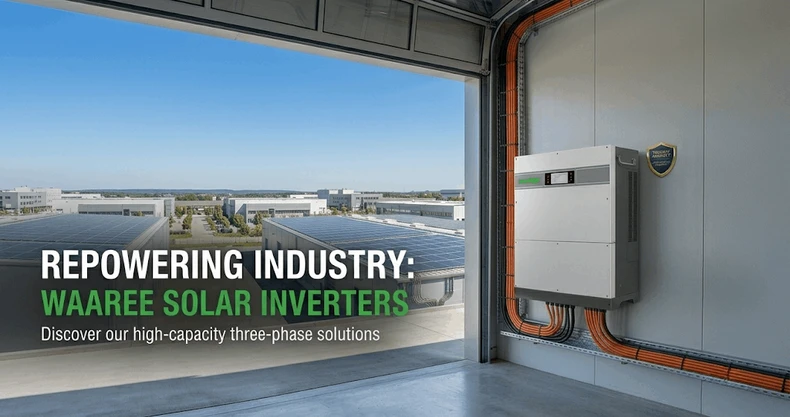
Commercial and industrial institutions typically have larger electricity requirements than residential properties. With companies looking to find ways of lowering electricity costs as well as increasing energy efficiency, on-grid solar systems have assumed significance. An essential part of such a system is an inverter, which is capable of converting the direct current (DC) produced by solar panels into alternating current (AC) so it can be used by appliances or sent to the power grid.
When it comes to larger installations, a three-phase solar inverter is usually the best choice, as most commercial buildings require a three-phase system. However, various factors determine the process of selecting an inverter, such as its capacity, efficiency, compatibility, monitoring, safeguards, and long-term requirements.
What Is a Three-Phase Solar Inverter?
As the name suggests, a three-phase solar inverter is responsible for converting the DC electricity produced by solar panels into three-phase AC electricity. Three-phase electricity is frequently used by commercial and industrial appliances because of its ability to supply heavy electrical loads.
In contrast to residential systems that may resort to single-phase electricity, commercial establishments usually require a balanced three-phase supply, meaning that the inverter must be compatible with both the solar array and the building’s electricity supply.
Why Is an Inverter for 3 Phase Systems Important?
An inverter for 3-phase is created for working with three-phase electricity supply, which is why it is used by offices, factories, warehouses, retail outlets, schools, and other commercial establishments that need large amounts of energy. When you choose the right inverter for solar panel systems, not only will you be able to handle larger solar power problems, but you can also make use of the generated electricity. This should make the solar system more compatible with the electricity network.
How to Choose the Right Inverter for Commercial Use?
In order to know how to choose solar inverter technology, it is important to understand how a solar installation works in general. Businesses should consider the aspects below before making a choice.
1. Look at Inverter Capacity
The inverter needs to be matched with the level of solar panel capacity and the amount of electricity to be used in the future. If the inverter is too small, the solar installation may not operate at its full potential, while if the inverter is oversized, it may cost too much.
The ideal inverter capacity is connected to the future development of the business. For example, a growing facility may want to plan ahead with higher capacity options such as 60kW or 80kW three phase inverters rather than resizing the system later.
2. Pay Attention to Efficiency
An inverter performs its main function of transforming DC electricity into AC electricity. During this process, the inverter loses some energy. Therefore, we can say that an efficient device will help reduce losses, as well as increase the efficiency of the solar installation in total.
3. Analyse Electrical Compatibility
Apart from the above-mentioned factors, it is essential to check the voltage, frequency, phases, and other electrical features of the building before choosing an inverter. The inverter in use needs to be in proper working order with solar panels, electrical loads, and the electricity grid. Businesses can use a solar calculator to get a clearer estimate of their load requirements before finalising a model.
To ensure the chosen equipment fulfils the requirements of the site for commercial projects, one must seek professional advice.
4. Availability of Monitoring Features
The availability of monitoring features helps to monitor the solar energy produced by the system. It is also helpful in case of problems faced during its operation.
An effective monitoring system in commercial solar projects is useful for the information it provides about energy production.
5. Protection Features
Protection features providing safety from electrical conditions such as overload, overheating, etc. are important as well because they make operations safer.
Businesses need to check the protection features before choosing their inverter.
What Determines Three Phase Inverter Price?
The price of a three-phase inverter can change depending on many factors such as capacity, efficiency, technology, monitoring features, protection functions, specifications, and manufacturer.
It is also not wise to choose an inverter only because it costs less. Other aspects, including reliability, warranty, technical support, compatibility, and long-term performance, have to be looked into. The required inverter capacity depends on the following:
- Solar panel capacity
- Electricity consumption
- Peak electrical load
- Grid connection requirements
- Operational schedule
- Plans for future expansion
Proper site inspection provides information regarding inverter capacity and system design. The Waaree Three Phase On Grid Inverters are a good choice for those looking for the right equipment for commercial or industrial solar installations. Businesses can also explore Commercial and Industrial Solar Kits for a more complete setup. The specific model is offered based on the needs and capacity of the installation.
Conclusion
Picking the appropriate inverter for the commercial solar system doesn’t just require comparing various options or picking the most economical one. When choosing the inverter for commercial purposes, companies should take into account the capacity of solar panels, electrical loads and efficiency, compatibility of the solar system components, features, monitoring options, possible protection functions, and expected future consumption of electricity.
The correct three-phase solar inverter will suit the electrical system of the facility. By studying and analysing the specifications, companies are able to make the right investment decision about solar energy.
Frequently Asked Questions
1. What Is a Three-Phase Solar Inverter?
A three-phase solar inverter is an inverter that transforms the electricity produced by solar panels into three-phase AC suitable for electrical loads or feeding into the grid.
2. Why Are Three-Phase Inverters Suitable for Commercial Buildings?
A 3 phase inverter is needed since it is specially constructed for three-phase electrical supply and large electrical loads that are typical for commercial buildings.
3. What Factors Affect Three-Phase Inverter Price?
The three-phase inverter cost depends on many factors, including its capacity, efficiency, type of equipment, monitoring devices, protective functions, manufacturer, etc.
4. How Do I Choose a Solar Inverter?
When figuring out how to select a solar inverter, you have to take into account solar panel capacity, electrical loads and voltage, phase configuration, efficiency, compatibility, protective functions, monitoring capability, and expected future developments.
5. Can a Three-Phase Inverter Be Used for Commercial Solar Systems?
Yes, a three-phase inverter can be used in a commercial solar system if its specifications match the requirements of the solar panel, electrical load, and the three-phase network.


