
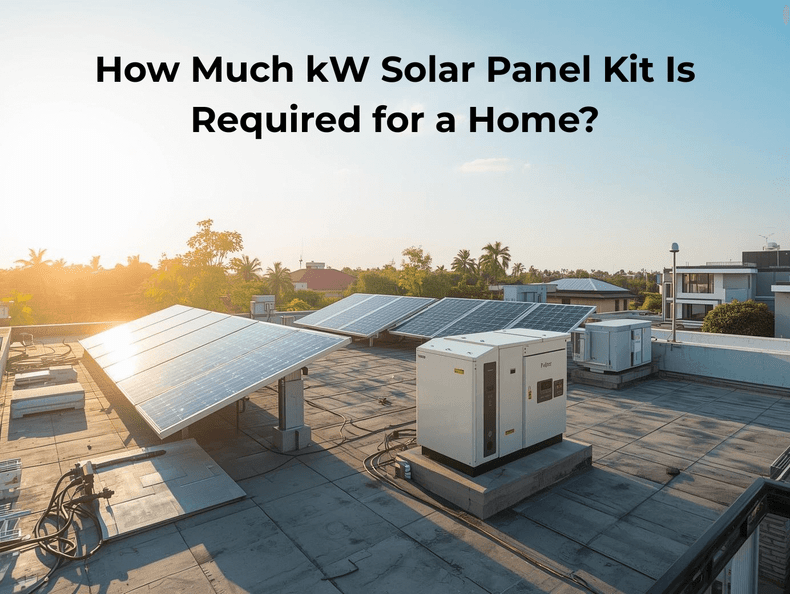
Choosing to go for a solar panel kit is one of the best decisions one can make, and this is when one often comes with a question: how many kW of a solar panel kit is required for home use? Installing and adopting the right size allows for the desired power supply without spending much on the high-wattage panels or underutilising the rooftop space.
The solar panel capacity for a home can be determined by evaluating the average electricity consumption in the home, the number of residents, the various appliances used throughout the day, plans, as well as the dependency on grid power.
Why the Capacity of Solar Power Kit for Home Matters
The right size of solar power kit for home chosen helps save on the electricity consumed, optimum utilisation of the roof space to what is desired, while maximising energy output, resulting in quicker return on investment.
When deciding how much kW solar panel kit is required for a home, one must evaluate future needs to avoid having to change solar panels frequently.
How to Calculate Solar Panel Capacity for a Home?
When calculating the approximate solar panel capacity for a home, first go through the monthly electricity bill. Now divide the total monthly consumption by 30 to understand the average daily consumption. Typically,
- 1 kW solar system generates 4–5 units per day
- Monthly generation is approximately 120–150 units
This helps you understand and estimate better how many kW solar panel kit is required for your home.
3kW Solar System: Ideal for Small to Mid-Sized Homes. For smaller homes that house 3-5 members and have moderate energy consumption, 3kw solar system for the home is apt and can be best used for
- Fans and lights in every room
- Can power TV, fridge and washing machines
- Can be used to run laptops and routers all day long
WAAREE Radiance 3.2 kW On Grid Single Phase Bifacial Topcon DCR Solar Kit, paired with high-efficiency mono PERC panels designed for consistent residential performance, is one of the best solar power kits for the home that ensures energy savings at affordable upfront costs.
4kW Solar System: When You Need More Backup and Flexibility
A 4 kW on-grid solar system, like WAAREE Radiance 4.5 kW On Grid Single Phase Bifacial Topcon DCR Solar Kit is ideal for use where there is stable connectivity. commonly preferred in areas with stable grid connectivity. This system works by feeding excess power back to the grid, thereby reducing electricity bills and supporting daily energy needs. The energy can be used to power air conditioners, washing machines, refrigerators, and work-from-home setups.
- Power 2–3 air conditioners
- It can be used to run water heaters regularly
- This solar panel capacity for the home acts as a power backup in areas where there are frequent grid failures.
5kW Solar System: Best for Large Homes and High Consumption
Go for a 5kw solar system for the home if you have an independent home or large apartments with several members in the family and corresponding higher electricity usage. This type of panel can be used to run several appliances simultaneously at home, like air conditioners, home appliances in the kitchen, television, laptops, music systems and much more.
Advantages of a 5kW System
- Helps reduce dependency on grid power, thereby reducing energy bills
- Ideal for families with multiple members, and especially where there are work-from-home setups
- Helps plan for the future, where there can be an increased number of appliances.
For higher output and long-term durability, homeowners often opt for the WAAREE Radiance 5 kW On Grid Single Phase Bifacial Topcon DCR Solar Kit, which supports both grid connectivity.
Roof Space Requirement for Different Solar Capacities
Make sure to consider the availability of rooftop space when evaluating the solar panel capacity for your home.
Ideally, space should be available as follows:
- 3 kW system: 250–300 sq. ft.
- 4 kW system: 325–400 sq. ft.
- 5 kW system: 400–500 sq. ft.
Cost Expectations and Subsidy Benefits
The price of a solar system depends on configuration and the type of installation. The Government offers adequate subsidies, making the installation of a solar power kit for the home affordable for many. Here is the cost, approximately, before the government subsidy:
- 3 kW: ₹1.2 – ₹2.2 lakh
- 4 kW: ₹1.8 – ₹2.8 lakh
- 5 kW: ₹2.5 – ₹3.8 lakh
The right solar capacity chosen plays an important role in making available a continuous supply of power with reduced dependency on the grid, with reduced electricity bills, and creating a power backup in areas of frequent power cuts. However, before picking the right kit, one must evaluate the usage patterns and understand system capabilities to pick one that balances cost, efficiency, and future readiness. Reach out to our team at Waaree.com to help you transition to solar with confidence.
Frequently Asked Questions (FAQs)
- How do I know exactly how much solar capacity my home needs?
Make sure to assess the average monthly electricity consumption and divide by 120 to estimate the required kW.
- Is a higher kW system always better?
Not necessary. If the energy consumption is less, make sure to go for a lower kw system to prevent increased costs without any proportional benefits.
- Can I start with a smaller system and expand later?
Most systems from reputed brands allow for expansion. However, before picking the system, check for the available space on the roof and the capacity of the inverter.
- Does off-grid solar require more panels?
Battery-backed systems may need slightly higher capacity to ensure reliable storage.
- Is buying a complete kit better than sourcing parts separately
It is recommended to go for a completely packaged system to avoid compatibility issues and ensure smooth, safe, and easy installation.




