

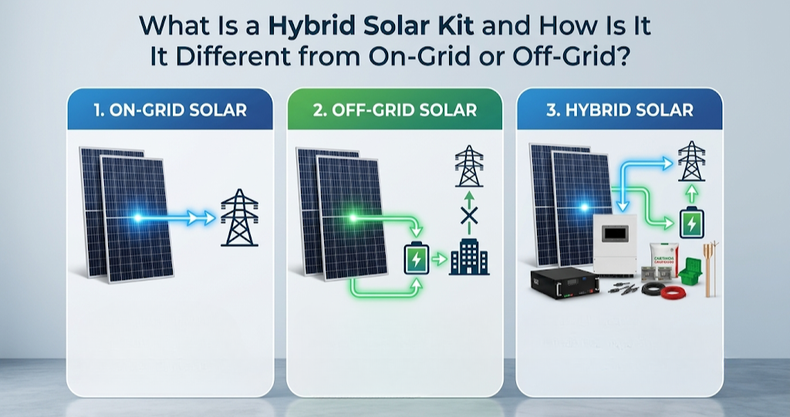
With rising electricity prices and power outages prompting more and more households in India to opt for solar energy, a number of options are available. Choosing between a hybrid system, an on-grid or off-grid system can completely change your experience, and not making the correct choice can make you spend way too much on your electricity bills or get left without power at the most crucial moment. In this guide, you will learn what a hybrid solar kit is and how it differs from on-grid and off-grid systems, helping you choose the best solution for your home.
How Does a Hybrid Solar System Work?
A hybrid solar system is able to combine the benefits of on-grid systems and off-grid systems, having features of both. It is constantly connected to the electrical grid. Though it does not look much different from an on-grid solar system, the difference is that a hybrid solar system has a battery for energy storage, similar to an off-grid system. It means that the system is capable of using energy from solar panels while it is sunny, charging its battery, and using this battery in the event of a blackout.
In fact, the components of a hybrid solar system are connected to each other and work in tandem due to a smart hybrid inverter. Therefore, the system is capable of using solar energy, batteries, and the electrical grid. A standard hybrid solar kit combines all the components needed for installation into a single package so that you do not have to individually procure the parts. For instance, the Waaree Radiance-Lite 3kW Hybrid Solar Kit comes as a package of 11 components, which include the solar panels, hybrid inverter, LFP battery module, the DCDB and ACDB protection devices, the MC4 connectors, and a complete earthing kit. Homes with large power needs can consider the Waaree Radiance-Lite 5kW Hybrid Solar Kit, which uses a 5K hybrid inverter and two battery modules for more backup.
At the core of any hybrid solar kit is the hybrid inverter, which is responsible for the intelligent management of solar, battery, and line power, including features like dual MPPT function and remote monitoring via WiFi.
What's Inside a Hybrid Solar Kit?
A standard hybrid solar kit combines all the components needed for installation into a single package so that you do not have to individually procure the parts. For instance, the Waaree Radiance-Lite 3kW Hybrid Solar Kit comes as a package of 11 components, which include the solar panels, hybrid inverter, LFP battery module, the DCDB and ACDB protection devices, the MC4 connectors, and a complete earthing kit. Homes with large power needs can consider the Waaree Radiance-Lite 5kW Hybrid Solar Kit, which uses a 5 kW hybrid inverter and two battery modules for more backup.
At the core of any hybrid solar kit is the hybrid inverter, which is responsible for the intelligent management of solar, battery, and line power, including features like dual MPPT function and remote monitoring via WiFi.
On-Grid Solar Systems: Grid-Connected, No Backup
The on-grid system connects electricity from the grid directly without any battery storage. During the day, the panel generates electricity for the house while the surplus electricity is fed back to the grid in return for credits via net metering. While there is a blackout happening, the grid systems will go off for safety reasons, and you have no power in this case. On-grid systems are also the least expensive systems available.
Off-Grid Solar Systems: Independent, Battery-Reliant
The system utilizes only solar panels and energy storage systems to provide all the electricity it requires, making it popular in remote regions with no access to the electrical power grid. Off-grid systems need to be constructed smartly enough for users to be able to use batteries for about two days with no sun, and this ultimately leads to the need to create a larger battery storage unit than in the case of hybrid systems.
Hybrid Solar System vs On-Grid vs Off-Grid: Key Differences
- Grid Connection: On-Grid has a grid connection with no backup; Off-Grid does not have any connection; Hybrid Solar Battery has a connection but uses battery backup.
- Source of Energy in Case of Outages: On-Grid systems turn off when the power is out; Off-Grid and Hybrid systems will be able to generate power by means of battery energy.
- Cost: On-Grid systems are the least expensive since there is no battery; Off-Grid systems are the most expensive due to the need to store energy since they can produce power in the hours of sunlight; Hybrid Solar Systems have a middle price since it is cheaper, as it needs much less energy storage.
- Use Cases: On-Grid is for places with a reliable electricity supply; Off-Grid systems are for remote areas with no supply; Hybrid systems are most suitable for places where people want to save money and also maximize electricity supply. Particularly in regions with instances of erratic power outages, hybrid solar system kits are the most sensible solution. The benefits include a reduction in power expenditure due to solar energy received during the day while avoiding installing huge and pricey batteries, as electricity from the grid can be used when solar energy supplies are exhausted. Most hybrid kits, such as the ones described above, can qualify for government incentives, which help maximize the return on investment.
Why Homeowners Are Choosing Hybrid Solar Kits
Particularly in regions with instances of erratic power outages, hybrid solar system kits are the most sensible solution. The benefits include a reduction in power expenditure due to solar energy received during the day while avoiding installing huge and pricey batteries, as electricity from the grid can be used when solar energy supplies are exhausted. Most hybrid kits, such as the ones described above, can qualify for government incentives, which help maximize the return on investment.
In Conclusion
The ultimate choice of either an on-grid, off-grid, or hybrid system will depend on the reliability of the grid supply and the amount of backup needed during outages. The hybrid solar system offers the best of both worlds by combining savings during the day with a backup supply of dependable power, so most families will choose that option. When making a decision, it is possible to compare various options available in hybrid solar kits with respect to their capacity and battery configurations.
FAQs
- What is a hybrid solar system in simple terms?
A hybrid solar system is an arrangement that combines the solar power generated with battery power and power from the grid when required.
- Is a hybrid solar kit more expensive than an on-grid system?
Yes, a hybrid solar system kit is more expensive than an on-grid system due to the inclusion of a battery and hybrid inverter, but it allows receiving backup power during blackouts, unlike a standard grid-connected system.
- Can a hybrid solar power system work without a battery?
No, the battery is a significant component of a hybrid solar power system because it allows for receiving backup power during blackouts. Otherwise, the system behaves just like a regular grid-connected system.
- Do hybrid solar systems qualify for government subsidies in India?
A number of hybrid solar system kits may receive benefits under schemes such as PM Surya Ghar Muft Bijli Yojana; however, since eligibility depends on the system capacity and relevant requirements of either the state or central government, not all kits will qualify for the subsidies.
- Which system is better for homes having power cut problems, an off-grid or a hybrid one?
For most homes that are still connected to the grid, a hybrid solar system is a better choice since it uses a smaller and cheaper battery compared to an off-grid system and provides backup supply.


