
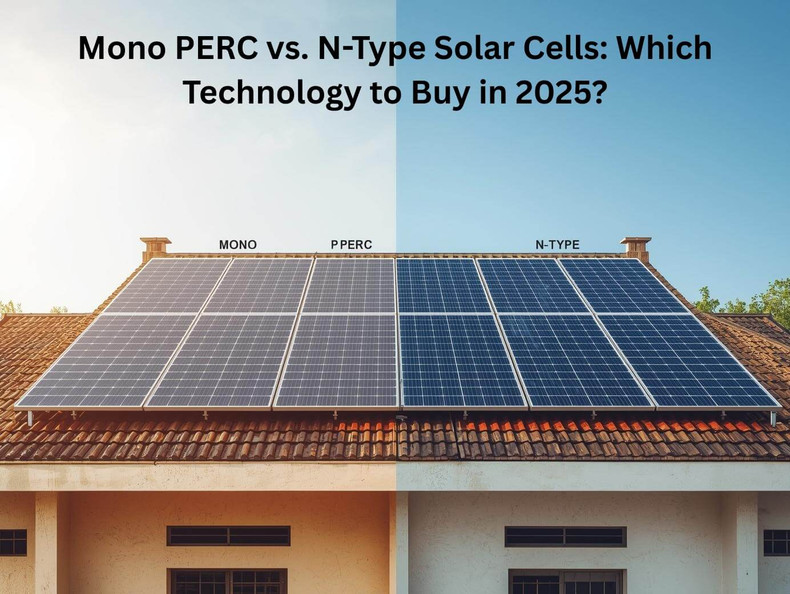
As India moves rapidly toward clean energy adoption, choosing the right solar module technology has become more important than ever. Homeowners, industries, and commercial buyers now evaluate not just price but long-term efficiency, durability, and performance. Among the most popular choices today are mono-perc solar panels and n-type solar panels that are robust, durable, and reliable, offering excellent performance. It is essential to first evaluate the energy demand at one’s place, the long-term energy goals, and know the pros and cons of the available different types of solar panels to pick one that best matches one’s requirements.
Mono PERC Technology Overview
Mono PERC (Passivated Emitter Rear Cell) is one of the commonly used technologies in the Indian solar market. These solar panels work on a single-crystal silicon structure in combination with a passivation layer present at the back of the cell, allowing for more absorption of sunlight, offering better performance in limited lighting.
Here are some important aspects of mono perc technology to be considered.
- They perform better at the start and end of the day.
- Offer higher efficiency than regular polycrystalline modules
- Has improved temperature tolerance
- It is designed to be reliable for the Indian climate.
Most residential buyers like proven and affordable mono perc panels given the stability the technology promises. In addition, it is widely adopted across homes, commercial rooftops, and small businesses, making it a trusted choice for standard installations.
N-Type Solar Panels Overview
While PERC has been dominant for years, the shift toward n type solar panel technology is stronger for those looking for maximum output from limited roof space. These panels use a different base material that resists electron recombination, resulting in higher long-term efficiency.
Benefits of the N-Type technology include the following:
- Lesser degradation over time
- Very high performance at elevated temperature.
- Improved performance of LID and PID
- More powerful output per square meter
Because of these reasons, many new installations across industries and utility-scale projects are shifting towards n type solar panel designs that are durable and can deliver consistent energy for decades. Given the Indian climatic conditions, where temperatures rise notably, n type panel offers a major benefit in terms of stable output.
PERC vs. N-Type Mono: Performance Comparison
Customers should be allowed to compare how mono PERC solar panels fare against N-Type under realistic conditions to enable them to make an informed choice.
Efficiency
N-Type: More efficient with better long-term retention
Mono PERC: Efficiency is very good, a little less than N-Type
Temperature Coefficient
N-Type: Performs well in high temperatures, quite good for sunny areas.
Mono PERC: Slightly lower production during peak summer months
Degradation rate
N-Type: Very low; retains much of its capability even up to 20–25 years
PERC solar panels: gentle degradation over the years.
Performance in Shade
N-Type: To minimize the total power loss
Mono PERC: Does well but not as good in terms of longevity as n type solar panel.
Cost Comparison
Mono PERC: More Economic and prevalent
N-Type: Slightly Higher upfront cost - Better output over the system lifetime
Which to Choose in 2025?
It will be right to choose according to the goals, budget, and rooftop conditions.
Go for Mono PERC if:
- You want value for your money.
- Your energy needs are average
- You prefer a module type that has been widely tested and proven.
- Your roof is sufficiently sized.
Mono PERC solar panels continue to provide high value and reliable performance for many households and small businesses.
Go for N-Type if:
- You want maximum generation from limited roof space.
- You live in hot areas or places where the temperature fluctuates a lot throughout the day.
- Long-term efficiency, minimal degradation-that's what matters to you.
- You need a future-ready system with improved performance metrics.
As more Indian manufacturers are moving to high-efficiency modules, demand for n-type solar panel technology is projected to take off significantly by 2025.
Long-term value and trends of future adoption
It is highly evident that the Indian solar marketplace is gradually shifting towards premium, high-output technologies. While perc solar panels continue to be strong, the progression and adoption of advanced architectures are clear. Indeed, many buyers today consider not only price but also full lifecycle performance, strength of warranty, and capability to consistently maintain energy output over several decades.
Power needs are rising, and with more homes adopting solar-plus-storage setups, N-Type modules take centre stage for next-generation systems. However, mono perc technology will be relevant due to its affordability and adaptability across different rooftops.
Mono PERC and N-Type are both strong moves in solar technology, suited for different needs. Mono Perc panels are affordable, reliable, and offer excellent performance. Making it suitable for most households and small businesses' needs. N-Type modules are more efficient, with longer lifespan and lesser degradation, making them ideal for those looking for long term investment. Knowing the requirements, long-term goals, the space in one’s roof, energy demand and in detail about each type of technology helps one make an informed decision. Reach out to the team at Waaree for more detailed consultation, to pick one that best suits your needs.
Frequently Asked Questions
1. Are N-Type panels worth the extra money?
Yes, they produce more electricity, degrade more slowly, and offer higher long-term value compared to mono perc panels.
2. How efficient are Mono PERC panels in Indian weather conditions?
Absolutely, they work efficiently in most climates, including areas with moderate to high temperatures.
3. Which is more suitable for small roofs?
N-Type panels are superior because they can deliver more power per square meter.
4. Are N-Type panels new in the market?
No, N-Type panels have been used globally for years, but their adoption has grown rapidly in India owing to the rise in demand for higher efficiency.
5. Which is better for long-term ROI?
N-Type generally offers better returns owing to lower degradation and higher generation, but mono perc offers strong value at a lower upfront cost.




