

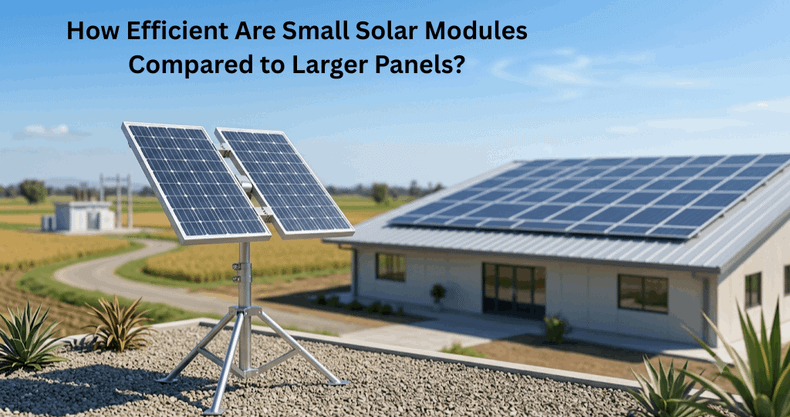
Solar panels can be manufactured in various sizes, wattages, and technologies to fill a given energy need. Usually, bigger panels are used for both home and business energy systems, but small solar modules are used in cases where reduced size and weight are a major issue. Hence, one of the key questions is whether small panels are less efficient than big ones.
The answer is not only about the size of the panel. All factors, including cell technology, wattage, construction, sunlight conditions, and purpose, play an important role in the level of efficiency and energy output.
What Are Small Solar Modules?
Small solar modules are small panels used for the production of energy needed for low-power needs. Small panels operate in different wattages and can provide electricity to solar street lights, garden lamps, batteries, mobile appliances, agricultural equipment, etc. Waaree offers a number of small solar modules ranging from 20 watts to 250 watts output.
For example, the WAAREE 100Wp 12V Small Solar Module can be used for solar street lights, solar lanterns, rural electrification, mobile solar systems, etc.
How Is Small Solar Panel Efficiency Measured?
Small solar panel efficiency refers to how effective the panel is in generating electrical energy from sunlight. The more efficient the panel is, the more electricity is produced for a given amount of sunlight and surface area. Small panels may be less efficient percentage-wise, but their small surface area and capacity could allow them to produce smaller amounts of electricity.
There are some factors that could influence energy generation, such as the type of solar cells used, conditions of installation, shading, sun orientation, intensity of sunlight, heat, etc.
What Do Small vs Large Solar Panels Have in Common?
The main difference between small solar panels and the big ones is in their capacity and purpose. The performance of large panels is enough to use them in kilowatt or even megawatt systems, while smaller ones are applicable in those areas where it is impossible or simply impractical to utilise large panels.
For instance, even though a 100Wp (Watt peak) solar module is not capable enough to operate an entire office building, it works wonderfully for various applications like street light power supply, small solar battery applications, artificial intelligence, etc.
What Are the Main Factors to Consider When Evaluating the Efficiency of a Solar Panel?
1. Solar Panel Efficiency and Cell Technology
To compare the efficiency of solar panels, one has to take into consideration a lot of factors like solar cell types, weather conditions, etc. For example, the 100Wp compact module by Waaree employs Mono PERC M10 cut-cell technology, which is effective in generating electricity and works well even in low-light conditions.
2. Available Installation Space
When there are spatial constraints, a compact module may be required instead of a larger module. Placing compact modules may be possible in places where larger traditional modules do not fit.
3. Energy Requirement
Before picking a module, it is important to consider the required power output. Compact modules should be chosen only for low-load applications, while larger models should be used only when substantial electricity generation is required. Waaree's small module range spans 20Wp to 50Wp for light-duty needs like mobile charging and IoT sensors, 100Wp to 150Wp for rural home lighting and small water pumps, and 200Wp to 250Wp for semi-off-grid setups and caravans.
4. Portability and Installation
Compact panels are much easier to transport and install than larger ones. Portable applications, such as mobile homes, temporary installations, caravans, or systems situated in difficult-to-access rural areas, benefit from the use of compact solar panels.
Are Small Solar Modules Less Efficient?
No, just the size of a solar panel is not an indicator of its efficiency. Small modules can perform very well if they are smartly designed with the application in mind.
However, larger panels usually generate more energy due to their larger surface area. Therefore, comparing the efficiency of large and small solar panels has to be done taking into account their efficiency, rated capacity, sizes, technologies, working conditions, and nature of application.
Conclusion
Small and large solar panels have different purposes and cannot be ranked based on one criterion. For high generation of electricity, larger panels are better suited, while small modules work well in portable, compact, low-load, and off-grid applications.
Make sure to analyse the technology of the panel, efficiency, available installation space, energy needs, and operating environment while comparing solar panel efficiency. Picking the right module will ensure efficient energy generation.
Frequently Asked Questions
1. Are Small Solar Modules Efficient?
Yes, the efficiency of small solar modules works well when they are applicable.
2. Are Small Solar Panels Less Efficient Than Large Panels?
No, small panels are not less efficient than large panels; their performance depends on the cell technology, availability of sunlight, panel design, and overall configuration.
3. What Are Small Solar Modules Used For?
Small solar panels and modules are used in solar streetlights, garden lights, battery charging, mobile devices, agricultural sensors, caravan applications, and other applications in low energy consumption and off-grid operation.
4. What Factors Affect Small Solar Panel Efficiency?
The efficiency of small solar modules is defined by different parameters of cell technology, sunlight intensity, temperature, and many other parameters of solar module technology.
5. How Should I Compare Small and Large Solar Panels?
It is better to compare small and large solar panels on the basis of efficiency, wattage, size, type of cell technology, installation, and use rather than just size comparison.


