

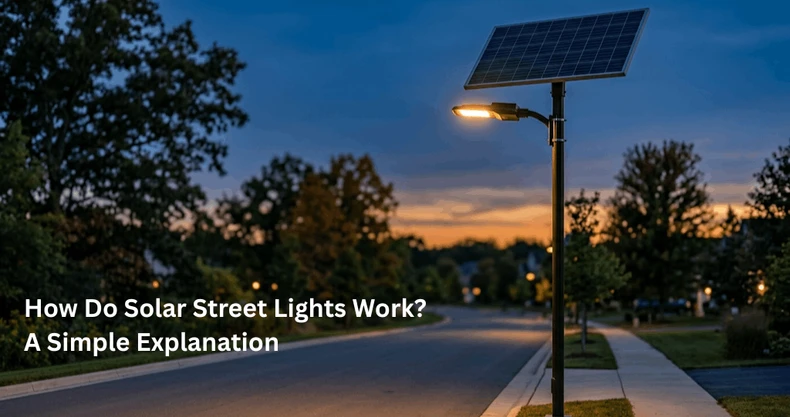
Solar street lights are increasingly used to illuminate streets, paths, parking lots, communities, and other public areas. Unlike conventional street lights that rely on grid electricity, solar street lights use sunlight during the day to convert the sun's rays into energy to power lights at night.
Solar street lights consist of photovoltaic technology, battery storage, automatic controls, and LED lighting as part of one outdoor lighting system. The system saves energy and utilises it at night after producing energy from the available sunlight during the day! In order to understand the operation of solar street lights, it is better to look at the functions of various components of the system to see how they work.
How Does a Solar Street Light Generate Energy During the Day?
The process of solar street light operation starts with the solar panel. During the day, the photovoltaic cells absorb sunlight and turn it into energy.
The generated energy passes through a special charge controller and only then goes to the battery, where it is stored. The charge controller plays a large role as it controls the charging process and also protects the battery from getting too much energy.
The battery keeps energy that was produced during the day. The amount of energy stored varies based on the efficiency of the solar panel, the sunlight it receives, and the battery's capacity.
What Are the Main Components of a Solar Street Light?
The components of a solar street light system operate together to provide the process of solar energy capture and storage. A solar street light system consists of:
- Panel: absorbs energy from the sun;
- Battery: stores energy for nighttime
- LED light: operates when energy is saved;
- Charge controller: makes everything work properly;
- Light sensor: detects whether it is day or nighttime.
- Pole and Mounting Structure: Supports the entire lighting kit.
For instance, there is the WAAREE 60Wp 12V Mono PERC Solar Module, which is perfect for street light applications and charging batteries, hence allowing smaller off-grid lighting systems to work well.
How Does a Solar Street Light Work After Sunset?
As daylight decreases, the light sensor notices the change in ambient light conditions. Then, the controller turns on the light-emitting diode LED that draws electricity from the charged battery.
When energy is available for use, the relevant lighting system would provide illumination according to the programming settings as designed. How do solar street lights work at this stage? Certain types of systems may deliver a steady brightness level during nighttime, whereas other systems may involve light dimming or control and use light according to energy requirements.
LED technology is suitable because it delivers effective lighting but at a comparatively lower electricity consumption rate. Based on the system, the brightness can be adjusted during less busy hours as a means of conserving battery supply.
Can Solar Street Lights Work During Cloudy Weather?
Even when it's cloudy, solar panels will generate energy, although they may not be as effective as on bright, sunny days.
The battery would work as a reserve, collecting energy whenever there is an abundance of sunlight. The performance of solar street lights in case of long-lasting cloudy weather depends on the number of batteries and panels installed, the local weather conditions, and the number of hours that they should work.
Installation should also be taken into consideration. For example, the presence of trees or buildings may cause interruptions in the generation of solar power. The fundamental principle of the operation of solar street lights has various practical benefits:
- Less reliance on the electricity grid
- Automatically operates during the day and night
- Ideal for off-grid or remote areas
- Eco-friendly with LED lighting
- Easy to install
- Less need for electrical connections
If you’re looking at buying solar LED lights, ensure that you look at the entire system and not just the light itself. You need to consider the capacity of the panel, battery characteristics, wattage of the LED, expected hours of operation, and where the lights will be installed.
Conclusion
Solar Street lights combine electricity generation, storage, automatic control, and distribution of electricity in one compact system. The efficiency of the system is determined by various factors, such as the solar panel size, battery capacity, the power of the LED lights, the amount of solar energy received, and the solar panels’ tilt angle. You can explore Waaree’s outdoor lighting solutions for different outdoor lighting requirements.
Frequently Asked Questions
1. Do Solar Street Lights Work at Night?
Yes, the systems work at night using the electricity stored in the batteries during the day. Automatic switching of the lights is controlled by a controller.
2. What Are the Main Components of Solar Street Lights?
The main parts of solar street lights are the batteries, solar panels, control units, LED lights, etc.
3. Do Solar Street Lights Work on Cloudy Days?
Yes. Even when it's cloudy, the panel generates power.
4. How long do solar lights last at night?
The hours of operation depend on battery capacity, solar panel size, LED consumption, available sunlight, etc.
5. What to know before buying solar LED lights?
The first factors to consider before buying solar lights are the solar panels, battery specifications, hours of operation, installed features, etc.


